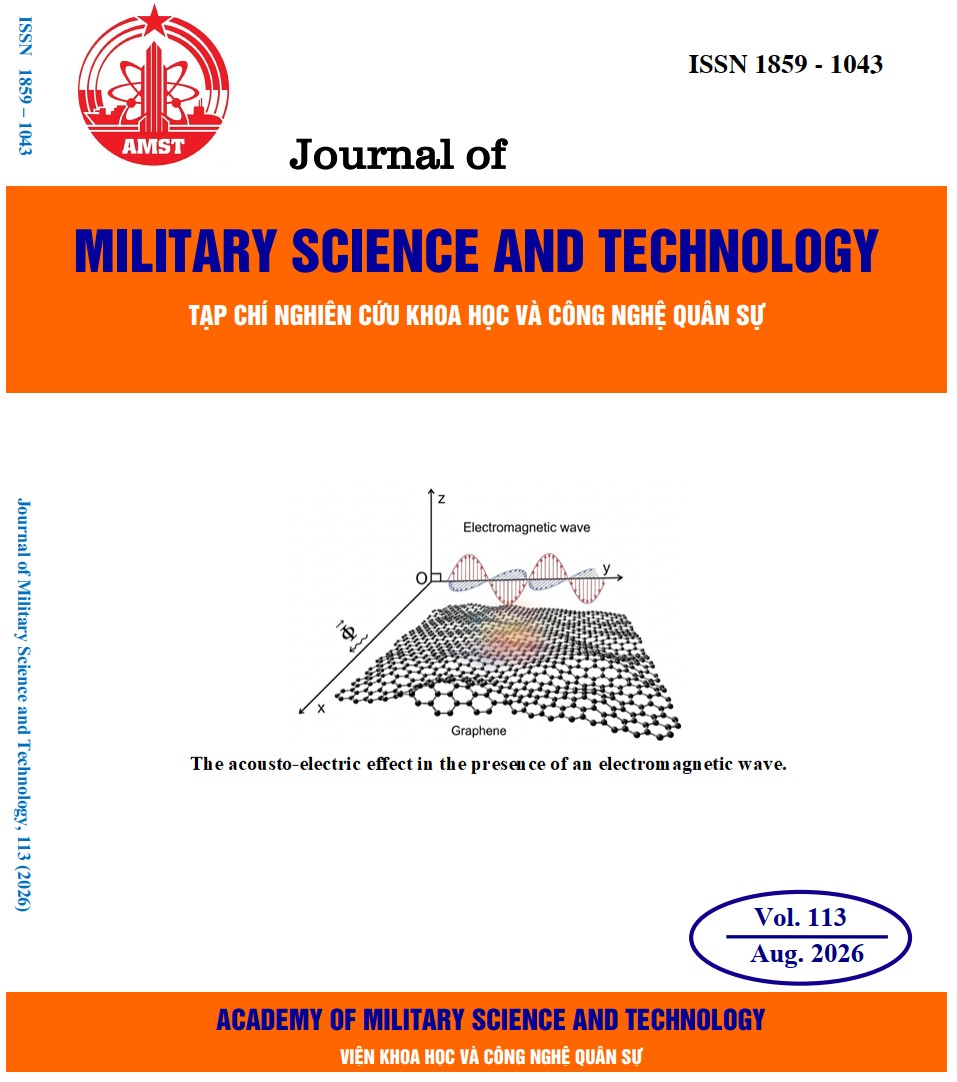
Acousto-electric current in graphene under the influence of electromagnetic waves
191 viewsDOI:
https://doi.org/10.54939/1859-1043.j.mst.113.2026.135-141Keywords:
Acoustic-electric effect; Surface acoustic waves; Two-dimensional graphene; Electromagnetic waves; Quantum kinetic equation; Electron-acoustic phonon scattering.Abstract
Two-dimensional graphene has garnered significant interest owing to its unique quantum behaviors stemming from a linear energy dispersion relation, with the acoustic-electric (AE) effect emerging as a key phenomenon driven by charge carrier dynamics under surface acoustic waves (SAW). Classical models based on the Boltzmann kinetic equation, effective at elevated temperatures, fall short in accounting for low-temperature experimental data. This work adopts the quantum kinetic equation approach to analyze the AE current in monolayer graphene subjected to combined SAW and electromagnetic waves (EMW). We derive an analytical formula for the AE current that fully captures the electron-acoustic phonon scattering via the deformation potential mechanism and elucidates SAW's role. Numerical simulations reveal the AE current's nonlinear rise with temperature, alongside sharp declines with increasing material sound velocity and EMW parameters. These trends highlight the potential for precise control of AE current via external stimuli. By advancing from classical to quantum frameworks, this study offers deeper insights into the AE effect's fundamentals in two-dimensional graphene.
References
[1]. T. Ando, “Theory of electronic states and transport in carbon nanotubes”, Journal of the Physical Society of Japan, Vol. 74, No. 3, pp. 777–817, (2005). DOI: https://doi.org/10.1143/JPSJ.74.777
[2]. S. A. Yang, “Dirac and Weyl materials: Fundamental aspects and some spintronics applications”, Spin, Vol. 6, No. 2, (2016). DOI: https://doi.org/10.1142/S2010324716400038
[3]. Vl. A. Margulis and E. E. Muryumin, “Giant quantum oscillations of acoustoelectric current in narrow graphene nanoribbons”, Journal of Physics D: Applied Physics, Vol. 57, No. 7, p. 075304, (2024). DOI: https://doi.org/10.1088/1361-6463/ad098c
[4]. Vl. A. Margulis and E. E. Muryumin, “Surface acoustic wave amplification by drifting electrons in semiconducting epitaxial graphene on silicon carbide”, Journal of Physics D: Applied Physics, Vol. 58, No. 1, p. 015308, (2025). DOI: https://doi.org/10.1088/1361-6463/ad8007
[5]. N. V. Hieu et al., “The influence of the electromagnetic wave on the nonlinear quantum acoustoelectric current in a quantum well”, Progress In Electromagnetics Research, p. 541, (2013).
[6]. S. Y. Mensah, F. K. A. Allotey and N. G. Mensah, “Nonlinear acoustoelectric effect in a semiconductor superlattice”, Journal of Physics: Condensed Matter, Vol. 12, No. 24, pp. 5225–5232, (2000). DOI: https://doi.org/10.1088/0953-8984/12/24/313
[7]. B. K. Ridley, “Quantum processes in semiconductors”, Oxford University Press, (2013). DOI: https://doi.org/10.1093/acprof:oso/9780199677214.001.0001
[8]. N. W. Ashcroft and N. D. Mermin, “Solid state physics”, p. 403, (1976).
[9]. S. Nafees et al., “Acoustoelectric current in graphene due to electron deformation potential and piezoelectric phonon couplings”, Physica Scripta, Vol. 97, No. 4, p. 045705, (2022). DOI: https://doi.org/10.1088/1402-4896/ac5b42
[10]. S. H. Zhang et al., “Piezoelectric surface acoustical phonon limited mobility of electrons in graphene on a GaAs substrate”, Physical Review B—Condensed Matter and Materials Physics, Vol. 87, No. 7, p. 075443, (2013). DOI: https://doi.org/10.1103/PhysRevB.87.075443
[11]. V. Miseikis et al., “Acoustically induced current flow in graphene”, Applied Physics Letters, Vol. 100, No. 13, (2012). DOI: https://doi.org/10.1063/1.3697403
[12]. S. Mayorov et al., “How close can one approach the Dirac point in graphene experimentally?”, Nano Letters, Vol. 12, No. 9, pp. 4629–4634, (2012). DOI: https://doi.org/10.1021/nl301922d
[13]. S. Adam et al., “Theory of charged impurity scattering in two-dimensional graphene”, Solid State Communications, Vol. 149, No. 27–28, pp. 1072–1079, (2009). DOI: https://doi.org/10.1016/j.ssc.2009.02.041
[14]. S. Okuda et al., “Graphene surface acoustic wave sensor for simultaneous detection of charge and mass”, ACS Sensors, Vol. 3, No. 1, pp. 200–204, (2018). DOI: https://doi.org/10.1021/acssensors.7b00851
[15]. Y. Mou et al., “Coherent detection of the oscillating acoustoelectric effect in graphene”, Physical Review Letters, Vol. 134, No. 9, p. 096301, (2025). DOI: https://doi.org/10.1103/PhysRevLett.134.096301
[16]. T. A. Tuan et al., “Two-dimensional graphene: Theoretical study of multi-photon non-linear absorption coefficient of a strong electromagnetic wave by using quantum kinetic equation”, Journal of the Physical Society of Japan, Vol. 92, No. 6, p. 064401, (2023). DOI: https://doi.org/10.7566/JPSJ.92.064401
[17]. W. M. Hartmann, “Signals, sound, and sensation”, Springer Science & Business Media, pp. 154–155, (2004).
[18]. L. Bandhu and G. R. Nash, “Temperature dependence of the acoustoelectric current in graphene”, Applied Physics Letters, Vol. 105, No. 26, (2014). DOI: https://doi.org/10.1063/1.4905222
[19]. R. Hanus et al., “Lattice softening significantly reduces thermal conductivity and leads to high thermoelectric efficiency”, Advanced Materials, Vol. 31, No. 21, p. 1900108, (2019). DOI: https://doi.org/10.1002/adma.201900108