Integrated dynamic modeling of a shipborne multiple rocket launcher considering actuation torques
9 viewsDOI:
https://doi.org/10.54939/1859-1043.j.mst.FMC.2026.61-69Keywords:
Multiple rocket launcher; Rocket projectile; Floating platform; Integrated dynamics; Vessel-launcher coupling; Numerical simulation.Abstract
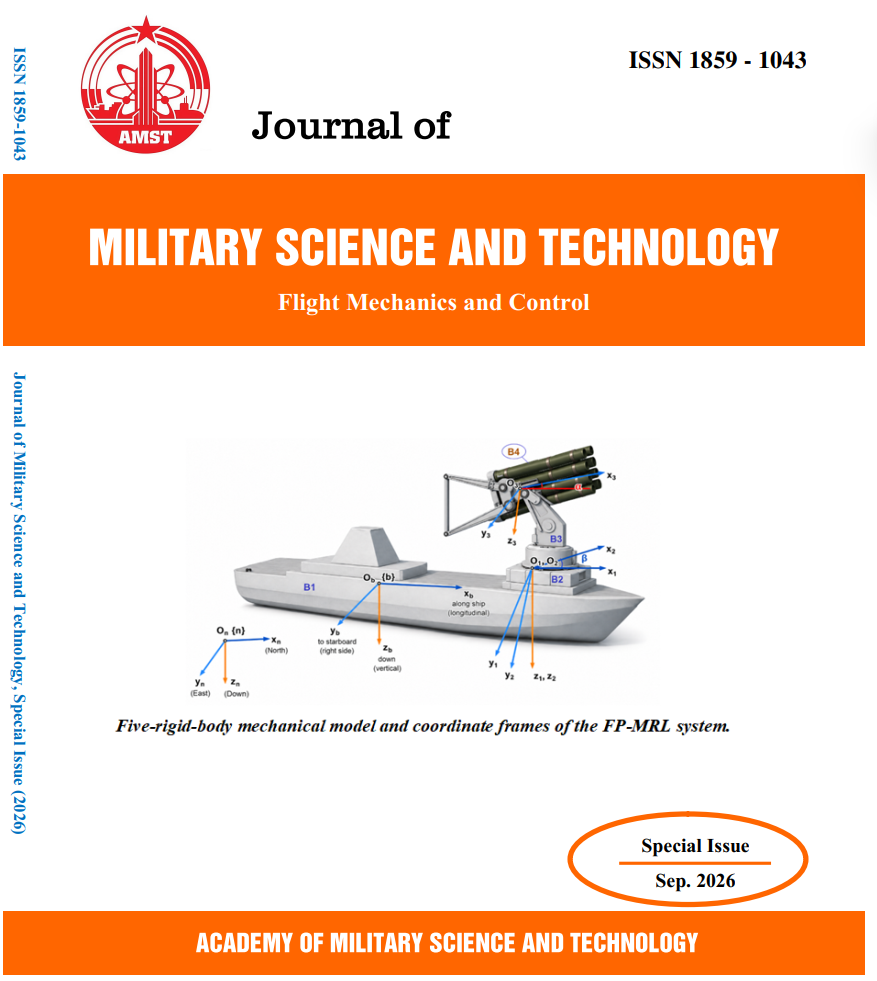
This paper develops an integrated dynamic model for a multiple rocket launcher (MRL) mounted on a floating platform (FP) and evaluates the model's structural consistency and computational feasibility through numerical simulations. The system is represented by five rigid bodies with a total of 11 degrees of freedom (DOFs). The 6-degree-of-freedom (6-DOF) dynamics of the FP are formulated using the Newton-Euler equations in a body-fixed reference frame, while the launcher subsystem, with five DOFs, is described by Lagrange's equations of the second kind in terms of generalized coordinates. The two formulations are coupled through the kinematic relations at the launcher mounting location and the corresponding interaction force-moment system. This hybrid formulation preserves the hydrodynamic structure of the FP model while providing a convenient representation of the launcher as a multibody chain. The model incorporates elastic-damping connections, environmental loads, launch loads, azimuth and elevation actuation torques, and an equivalent rocket package whose mass and inertia properties are updated according to firing events. The model is implemented in MATLAB, numerically integrated using the ode15s solver, and evaluated according to a PASS1-PASS2-PASS3 computational scheme. For the representative VH6-MTW7-KC4-DK4 scenario, the maximum roll angle of the FP decreases from 2.604° in PASS1 to 2.519° in PASS3, while the azimuth and elevation tracking errors remain bounded within the prescribed ±1° limit. The calculations involving the actuation torques, rocket-package updates, and sea-state variation are employed only to verify the functionality of the corresponding model components rather than to investigate in detail the individual influence of each factor. The results demonstrate that the proposed model is structurally consistent and computationally feasible. Parameter calibration and validation against experimental measurement data are identified as the next steps of the study.
References
[1]. Nguyen Xuan Anh, “Textbook on launcher calculations and launch dynamics,” Military Technical Academy, Hanoi, (1998).
[2]. Nguyen Van Khang, “Dynamics of multibody systems,” Science and Technics Publishing House, Hanoi, (2007).
[3]. Pham Hong Sinh, “Dynamic study of a launcher mounted on a wheeled vehicle,” Ph.D. dissertation, Military Institute of Science and Technology, (2011).
[4]. Nguyen Duy Phon, “Study on the influence of selected initial disturbances as an unguided rocket leaves the launcher on firing accuracy,” Ph.D. dissertation, Military Technical Academy, (2017).
[5]. T. I. Fossen, “Handbook of Marine Craft Hydrodynamics and Motion Control,” John Wiley & Sons, (2011). DOI: https://doi.org/10.1002/9781119994138
[6]. T. I. Fossen, “Guidance and Control of Ocean Vehicles,” John Wiley & Sons, 1994.
[7]. O. M. Faltinsen, “Sea Loads on Ships and Offshore Structures,” Cambridge University Press, (1990). DOI: https://doi.org/10.1146/annurev.fl.22.010190.000343
[8]. A. A. Shabana, “Dynamics of Multibody Systems,” 4th ed., Cambridge University Press, (2013). DOI: https://doi.org/10.1017/CBO9781107337213
[9]. L. F. Shampine and M. W. Reichelt, “The MATLAB ODE Suite,” SIAM Journal on Scientific Computing, vol. 18, no. 1, pp. 1-22, (1997). DOI: https://doi.org/10.1137/S1064827594276424
[10]. A. Babarit and G. Delhommeau, “Theoretical and numerical aspects of the open source BEM solver NEMOH,” Proceedings of the 11th European Wave and Tidal Energy Conference, Nantes, France, (2015).
[11]. C. Yu, D. Ma, and X. Zhang, “Launch process simulation of a ship-borne multiple launch rocket system,” World Journal of Modelling and Simulation, vol. 3, no. 1, pp. 58–65, (2007).
[12]. Tran Xuan Dieu, “Inverse kinematic analysis of a shipborne launcher model,” Journal of Military Science and Technology, no. 80, (2022).
[13]. Le Tien Dung, “Dynamics of a modified twin-barrel 37 mm gun mounted on a naval vessel and measures to ensure firing reliability,” Ph.D. dissertation, Military Technical Academy, (2012).