Thuật toán học phân cấp ICL-RCTAC điều khiển tối ưu bám quỹ đạo và thích nghi với nhiễu môi trường cho AUV trong mặt phẳng ngang
DOI:
https://doi.org/10.54939/1859-1043.j.mst.114.2026.3-11Từ khóa:
Phương tiện ngầm tự hành; Học tăng cường; Học đồng thời tích phân; Ổn định Lyapunov; Điều khiển thích nghi; Điều khiển tối ưu.Tóm tắt
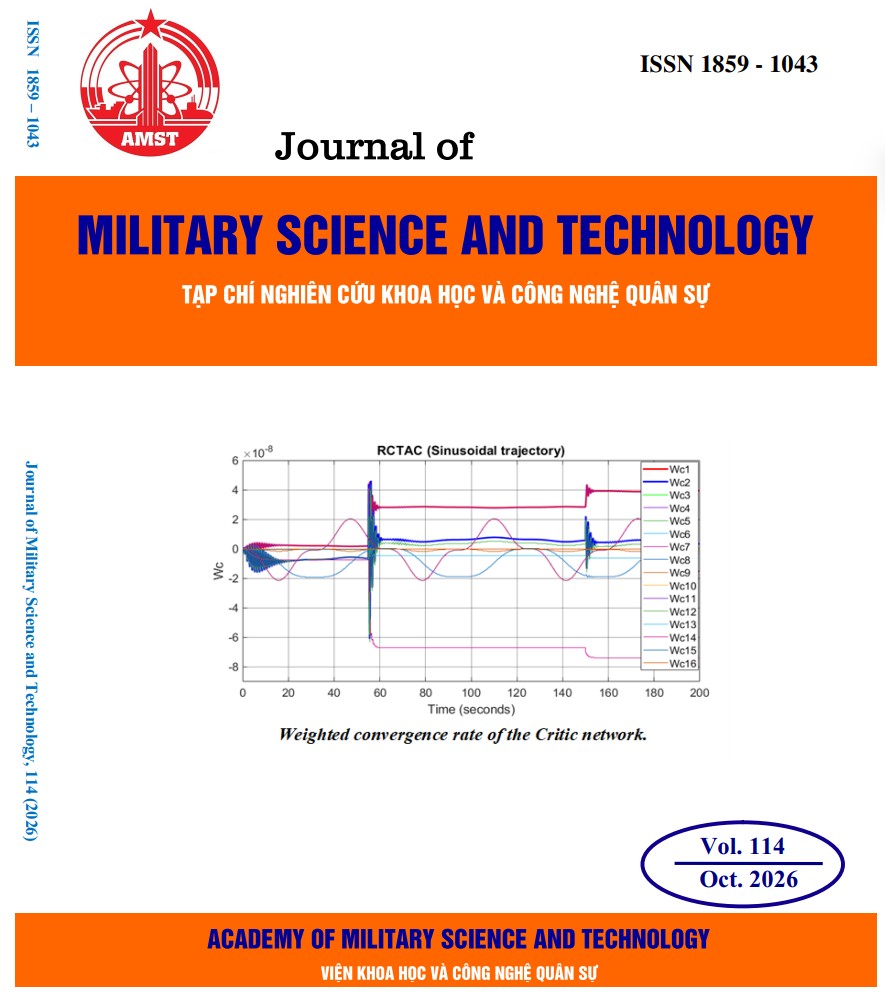
ICL-RCTAC là thuật toán học tăng cường phân cấp cho bài toán bám quỹ đạo tối ưu thích nghi của AUV trên mặt phẳng ngang, giải quyết hai hạn chế của học tăng cường thời gian liên tục — giai đoạn khởi động và điều kiện kích thích liên tục (PE) bằng khung điều khiển hai pha. Pha I sử dụng cơ chế học đồng thời tích phân (ICL) để khai thác dữ liệu lịch sử, nhằm xác định trọng số Critic ổn định dưới điều kiện kích thích hữu hạn (FE), với hội tụ được chứng minh trong Mệnh đề 1. Pha II kích hoạt vòng lặp Actor–Critic với điều kiện nới lỏng để tối ưu hóa chính sách một cách hiệu quả. Phân tích Lyapunov xác nhận rằng hệ vòng kín hội tụ đều và bị chặn (UUB). Mô phỏng MATLAB/Simulink 2024a cho thấy hội tụ nhanh hơn, sai số bám và nỗ lực điều khiển thấp hơn so với PID và RCTAC, qua đó khẳng định tiềm năng ứng dụng thực tiễn của AUV.
Tài liệu tham khảo
[1]. Dong Ma, Ye Li, et al., “The state of the art in key technologies for autonomous underwater vehicles: a review.” Ocean Engineering, (2025). DOI: https://doi.org/10.1016/j.eng.2025.08.002
[2]. Wibisono, A., Piran, M.J., Song, H.-K., Lee, B.M., “A Survey on Unmanned Underwater Vehicles: Challenges, Enabling Technologies, and Future Research Directions,” Sensors, 23, 7321, (2023).
[3]. Daoliang Li, and Ling Du, “AUV Trajectory Tracking Models and Control Strategies: A Review,” Journal of Marine Science and Engineering, 9, 1020, (2021). DOI: https://doi.org/10.3390/jmse9091020
[4]. Bach Nhat Hoang, Doan Trung Thanh, Phan Huy Anh, and Dang Tien Sy, “Research on solutions to enhance trajectory quality in underwater autonomous navigation of unmanned underwater vehicles using IEKF SLAM algorithm for SONAR data”, J. Mil. Sci. Technol., IITE, 27–34, (2025). DOI: https://doi.org/10.54939/1859-1043.j.mst.IITE.2025.27-34
[5]. Kairong Duan, Simon Fong, C.L. Philip Chen, “Reinforcement learning-based model-free optimized trajectory tracking strategy design for an AUV”, Neurocomputing, 469, 289-297, (2022).
[6]. Nguyen Van Duc and Sai Van Cuong, “Reinforcement learning algorithm for adaptive intelligent control”, J. Mil. Sci. Technol., CAPITI, 62–68, (2024). DOI: https://doi.org/10.54939/1859-1043.j.mst.CAPITI.2024.62-68
[7]. Duan, J., Li, S.E., Guan, Y., Sun, Q., and Cheng, B, “Relaxed actor-critic with convergence guarantees for continuous-time optimal control of nonlinear systems,” IEEE Transactions on Intelligent Vehicles, 8, 5, 3299–3311. DOI: https://doi.org/10.1109/TIV.2023.3255264
[8]. Parikh, A., Kamalapurkar, R., and Dixon, W.E, “Integral concurrent learning: Adaptive control with parameter convergence using finite excitation,” International Journal of Adaptive Control and Signal Processing, 33, 12, 1775–1787. DOI: https://doi.org/10.1002/acs.2945
[9]. T. I. Fossen, “Handbook of Marine Craft Hydrodynamics and Motion Control,” John Wiley & Sons, 2nd Edition, (2021).
[10]. Chunbin Qin, et al., “Adaptive Dynamic Programming without Persistence Excitation for Tracking in A Special Class of Linear Systems with Input Constraints,” 33rd Chinese Control and Decision Conference, (2021). DOI: https://doi.org/10.1109/CCDC52312.2021.9602844
[11]. S. Bhasin, et al., “A novel actor-critic-identifier architecture for approximate optimal control of uncertain nonlinear systems,” Automatica, 49, 1, 82-92, (2013).
[12]. H. K. Khalil, “Nonlinear Systems,” Prentice-Hall, 3rd ed., (2002).