A variance-reduced simulation for benchmarking CFAR detectors in non-homogeneous environments
297 viewsDOI:
https://doi.org/10.54939/1859-1043.j.mst.111.2026.39-51Keywords:
CFAR; Trimmed-mean; Variability-index; Monte Carlo; Variance reduction.Abstract
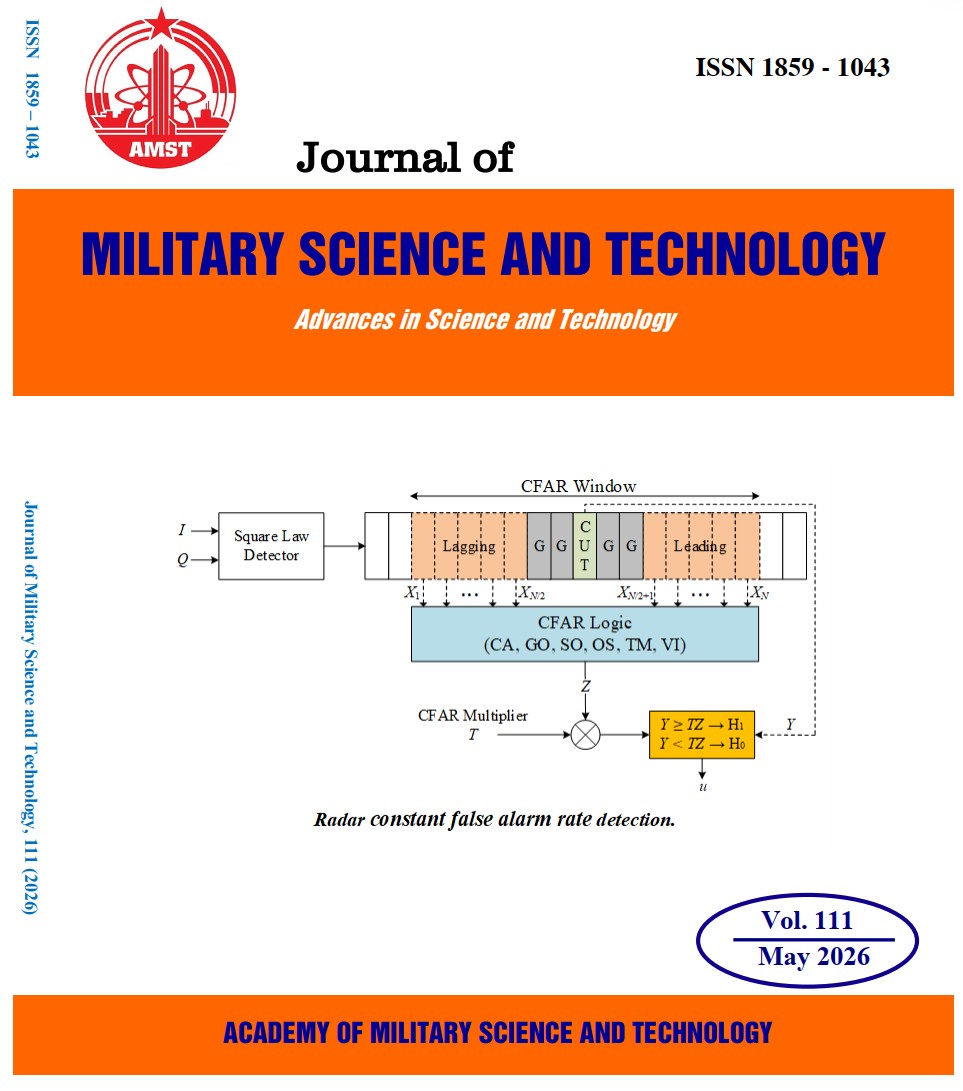
This paper presents an accurate and stable simulation framework for evaluating the detection performance of constant false alarm rate (CFAR) detectors in the presence of clutter non-homogeneity and interference. The proposed framework incorporates theoretically consistent threshold calibration for CFAR detectors and introduces a variance-reduced estimator for false-alarm probability based on conditional expectation. This approach enables reliable estimation of extremely small false-alarm probabilities without excessive computational cost. Clutter edge scenarios are modeled using an edge-aware formulation that ensures physical consistency between the reference window and the cell under test. Extensive numerical results validate the proposed framework under homogeneous clutter and demonstrate its effectiveness in analyzing detector robustness in the presence of multiple interfering targets and clutter edges. The results provide clear insight into the relative strengths and limitations of different CFAR detectors and highlight the importance of accurate simulation techniques for meaningful performance comparison in realistic radar environments.
References
[1]. M. A. Richards, J. A. Scheer, and W. A. Holm. “Principles of Modern Radar: Basic Principles”. London, U.K.: IET, (2010). DOI: 10.1049/SBRA021E.
[2]. G. Minkler and J. Minkler. “CFAR: The Principles of Automatic Radar Detection in Clutter”. Norwood, MA, USA: Artech House, (1990). DOI: 10.5555/575491.
[3]. H. Rohling. “Radar CFAR thresholding in clutter and multiple target situations”. IEEE Trans. Aerosp. Electron. Syst., vol. AES-19, no. 4, pp. 608–621, (1983). DOI: 10.1109/TAES.1983.309350.
[4]. P. P. Gandhi and S. A. Kassam. “Analysis of CFAR processors in nonhomogeneous background”. IEEE Trans. Aerosp. Electron. Syst., vol. 24, no. 4, pp. 427–445, (1988). DOI: 10.1109/7.7185.
[5]. G. V. Trunk. “Range resolution of targets using automatic detectors”. IEEE Trans. Aerosp. Electron. Syst., vol. AES-14, no. 5, pp. 750–755, (1978). DOI: 10.1109/TAES.1978.308625.
[6]. V. G. Hansen and J. H. Sawyers. “Detectability loss due to ‘greatest of’ selection in a cell-averaging CFAR”. IEEE Trans. Aerosp. Electron. Syst., vol. AES-16, no. 1, pp. 115–118, (1980). DOI: 10.1109/TAES.1980.308885.
[7]. M. E. Shor and N. Levanon. “Performances of order statistics CFAR”. IEEE Trans. Aerosp. Electron. Syst., vol. 27, no. 2, pp. 214–224, (1991). DOI: 10.1109/7.78295.
[8]. A. Di Vito, G. Galati, and R. Mura. “Analysis and comparison of two order statistics CFAR systems”. IEE Proc. Radar Sonar Navig., vol. 141, no. 2, pp. 109–115, (1994). DOI: 10.1049/ip-rsn:19949886.
[9]. B. Magaz, A. Belouchrani, and M. Hamadouche. “Automatic threshold selection in OS-CFAR radar detection using information theoretic criteria”. Prog. Electromagn. Res. B, vol. 30, pp. 157–175, (2011). DOI: 10.2528/PIERB10122502.
[10]. Y. Kong, Y. Wang, J. Cui, and X. Yang. “Performance prediction of OS-CFAR for generalized Swerling–Chi fluctuating targets”. IEEE Trans. Aerosp. Electron. Syst., vol. 52, no. 1, pp. 492–500, (2016). DOI: 10.1109/TAES.2015.140967.
[11]. Y. He and H. Meng. “Performance of a new CFAR detector based on trimmed mean”. Proc. IEEE Int. Conf. Syst., Man, Cybern. (SMC), (1996). DOI: 10.1109/ICSMC.1996.569880.
[12]. D. Tao, A. P. Doulgeris, and C. Brekke. “A segmentation-based CFAR detection algorithm using truncated statistics”. IEEE Trans. Geosci. Remote Sens., vol. 54, no. 5, pp. 2887–2898, (2016). DOI: 10.1109/TGRS.2015.2506822.
[13]. M. E. Smith and P. K. Varshney. “Intelligent CFAR processor based on data variability”. IEEE Trans. Aerosp. Electron. Syst., vol. 36, no. 3, pp. 837–847, (2000). DOI: 10.1109/7.869503.
[14]. M. A. Khalighi and M. H. Bastani. “Adaptive CFAR processor for nonhomogeneous environments”. IEEE Trans. Aerosp. Electron. Syst., vol. 36, no. 3, pp. 889–897, (2000). DOI: 10.1109/7.869508.
[15]. A. Sarma and D. W. Tufts. “Robust adaptive threshold for control of false alarms”. IEEE Signal Process. Lett., vol. 8, no. 9, pp. 261–263, (2001). DOI: 10.1109/97.948451.
[16]. V. Anastassopoulos and G. Lampropoulos. “Optimal CFAR detection in Weibull clutter”. IEEE Trans. Aerosp. Electron. Syst., vol. 31, no. 3, pp. 1161–1172, (1995). DOI: 10.1109/7.366292.
[17]. G. V. Weinberg. “Constant false alarm rate detectors for Pareto clutter models”. IET Radar Sonar Navig., vol. 7, no. 2, pp. 153–163, (2013). DOI: 10.1049/iet-rsn.2011.0374.
[18]. G. V. Weinberg. “Formulation of a generalised switching CFAR with application to X-band maritime surveillance radar”. SpringerPlus, vol. 4, art. no. 574, (2015). DOI: 10.1186/s40064-015-1347-2.
[19]. S. Asmussen and P. W. Glynn. “Stochastic Simulation: Algorithms and Analysis”. New York, NY, USA: Springer, (2007). DOI: 10.1007/978-0-387-69033-9.
[20]. V. Elvira and L. Martino. “Advances in Importance Sampling”. Wiley StatsRef: Statistics Reference Online, pp. 1–14, (2021). DOI: 10.1002/9781118445112.stat08284.
[21]. N. B. Rached, E. V. Schwerin, G. Shaimerdenova and R. Tempone. “Importance sampling for rare event tracking within the ensemble Kalman filtering framework”. Statistics and Computing, vol. 36, no. 1, pp. 1–35, (2025). DOI: 10.1007/s11222-025-10736-1.
[22]. C. J. Clopper and E. S. Pearson. “The use of confidence or fiducial limits illustrated in the case of the binomial”. Biometrika, vol. 26, no. 4, pp. 404–413, (Dec. 1934). DOI: 10.1093/biomet/26.4.404.
[23]. J. Xue, S. Xu, and P. Shui. “Near-optimum coherent CFAR detection of radar targets in compound-Gaussian clutter with inverse Gaussian texture”. Signal Processing, vol. 166, (2020). DOI: 10.1016/j.sigpro.2019.07.029.
[24]. K. Zebiri et al. “CFAR detection using two scale invariant functions in heterogeneous Weibull clutter”. SIViP, vol. 18, pp. 7285–7291, (2024). DOI: 10.1007/s11760-024-03393-w.
[25]. H. A. David and H. N. Nagaraja. “Order Statistics”. 3rd ed. Wiley, (2003).
[26]. M. B. El Mashade. “Detection performance of the trimmed-mean CFAR processor with noncoherent integration”. IEE Proc. Radar, Sonar and Navigation, vol. 142, no. 1, pp. 18–24, (1995). DOI: 10.1049/ip-rsn:19951626.
[27]. X. Chunbo and L. Yifan. “Adaptive Constant False Alarm Rate Detector Based on Long Short-term Memory Network”. Radioengineering, vol. 34, no. 1, pp. 132–142, (2025). DOI: 10.13164/re.2025.0132.