Mô phỏng giảm phương sai để đánh giá chất lượng các bộ phát hiện CFAR trong môi trường không đồng nhất
297 lượt xemDOI:
https://doi.org/10.54939/1859-1043.j.mst.111.2026.39-51Từ khóa:
CFAR; Trung bình-cắt; Chỉ số-biến thiên; Monte Carlo; Giảm phương sai.Tóm tắt
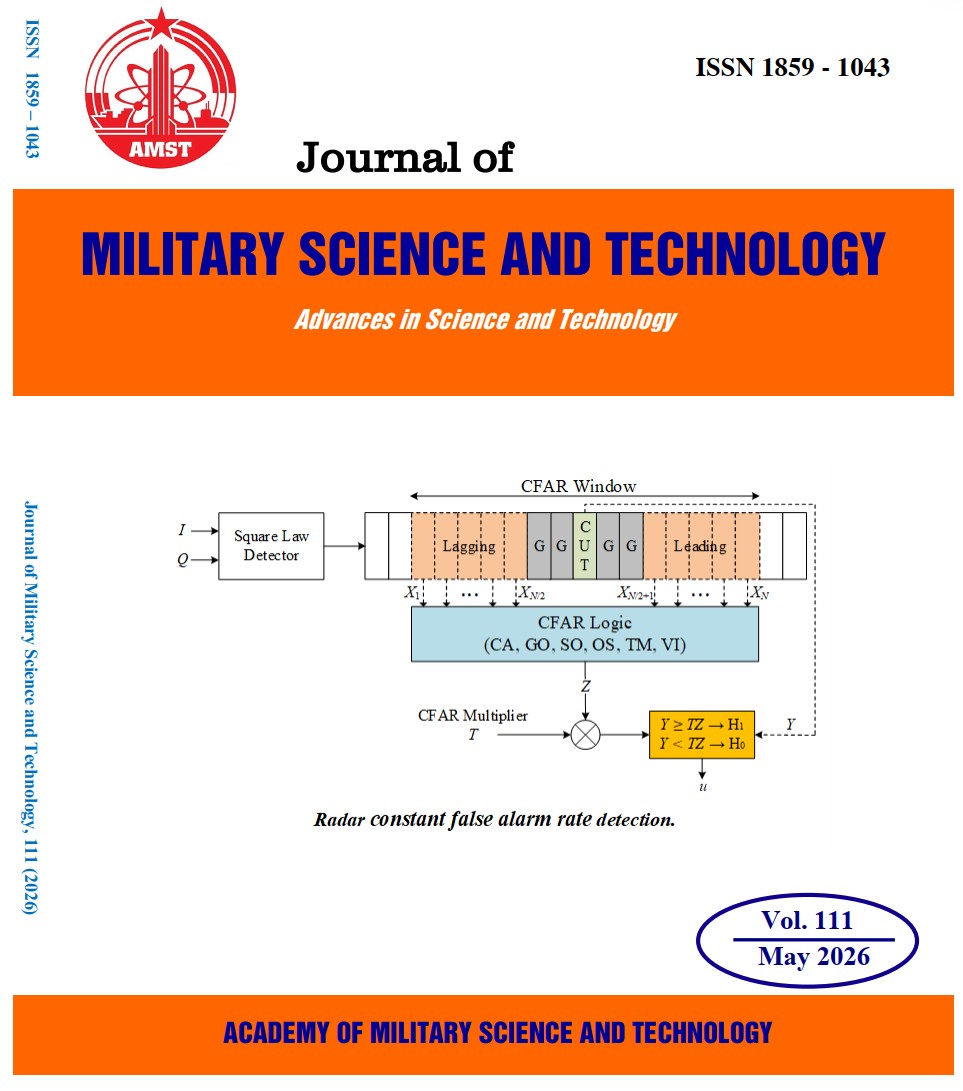
Bài báo này trình bày một phương pháp mô phỏng chính xác và ổn định để đánh giá chất lượng của các bộ phát hiện có ổn định xác suất báo động lầm (CFAR) trong điều kiện nhiễu không đồng nhất và mục tiêu gây nhiễu. Phương pháp đề xuất kết hợp việc hiệu chuẩn ngưỡng nhất quán về mặt lý thuyết cho các bộ CFAR và trình bày một bộ ước lượng giảm phương sai cho xác suất báo động lầm dựa trên kỳ vọng có điều kiện. Cách tiếp cận này cho phép ước lượng tin cậy các xác suất báo động lầm cực nhỏ mà không tốn quá nhiều chi phí tính toán. Các kịch bản sườn nhiễu được mô hình hóa bằng cách sử dụng mô hình nhận biết sườn, đảm bảo tính nhất quán vật lý giữa cửa sổ tham chiếu và ô kiểm tra. Các kết quả số đã được xác nhận trong điều kiện nhiễu đồng nhất và chứng minh hiệu quả của nó trong việc phân tích độ bền vững của bộ phát hiện khi có nhiều mục tiêu gây nhiễu và các sườn nhiễu. Kết quả này cung cấp cái nhìn sâu sắc về ưu điểm và hạn chế tương đối của các bộ CFAR, đồng thời nhấn mạnh tầm quan trọng của kỹ thuật mô phỏng chính xác để so sánh chất lượng phát hiện có ý nghĩa trong các môi trường ra đa thực tế.
Tài liệu tham khảo
[1]. M. A. Richards, J. A. Scheer, and W. A. Holm. “Principles of Modern Radar: Basic Principles”. London, U.K.: IET, (2010). DOI: 10.1049/SBRA021E.
[2]. G. Minkler and J. Minkler. “CFAR: The Principles of Automatic Radar Detection in Clutter”. Norwood, MA, USA: Artech House, (1990). DOI: 10.5555/575491.
[3]. H. Rohling. “Radar CFAR thresholding in clutter and multiple target situations”. IEEE Trans. Aerosp. Electron. Syst., vol. AES-19, no. 4, pp. 608–621, (1983). DOI: 10.1109/TAES.1983.309350.
[4]. P. P. Gandhi and S. A. Kassam. “Analysis of CFAR processors in nonhomogeneous background”. IEEE Trans. Aerosp. Electron. Syst., vol. 24, no. 4, pp. 427–445, (1988). DOI: 10.1109/7.7185.
[5]. G. V. Trunk. “Range resolution of targets using automatic detectors”. IEEE Trans. Aerosp. Electron. Syst., vol. AES-14, no. 5, pp. 750–755, (1978). DOI: 10.1109/TAES.1978.308625.
[6]. V. G. Hansen and J. H. Sawyers. “Detectability loss due to ‘greatest of’ selection in a cell-averaging CFAR”. IEEE Trans. Aerosp. Electron. Syst., vol. AES-16, no. 1, pp. 115–118, (1980). DOI: 10.1109/TAES.1980.308885.
[7]. M. E. Shor and N. Levanon. “Performances of order statistics CFAR”. IEEE Trans. Aerosp. Electron. Syst., vol. 27, no. 2, pp. 214–224, (1991). DOI: 10.1109/7.78295.
[8]. A. Di Vito, G. Galati, and R. Mura. “Analysis and comparison of two order statistics CFAR systems”. IEE Proc. Radar Sonar Navig., vol. 141, no. 2, pp. 109–115, (1994). DOI: 10.1049/ip-rsn:19949886.
[9]. B. Magaz, A. Belouchrani, and M. Hamadouche. “Automatic threshold selection in OS-CFAR radar detection using information theoretic criteria”. Prog. Electromagn. Res. B, vol. 30, pp. 157–175, (2011). DOI: 10.2528/PIERB10122502.
[10]. Y. Kong, Y. Wang, J. Cui, and X. Yang. “Performance prediction of OS-CFAR for generalized Swerling–Chi fluctuating targets”. IEEE Trans. Aerosp. Electron. Syst., vol. 52, no. 1, pp. 492–500, (2016). DOI: 10.1109/TAES.2015.140967.
[11]. Y. He and H. Meng. “Performance of a new CFAR detector based on trimmed mean”. Proc. IEEE Int. Conf. Syst., Man, Cybern. (SMC), (1996). DOI: 10.1109/ICSMC.1996.569880.
[12]. D. Tao, A. P. Doulgeris, and C. Brekke. “A segmentation-based CFAR detection algorithm using truncated statistics”. IEEE Trans. Geosci. Remote Sens., vol. 54, no. 5, pp. 2887–2898, (2016). DOI: 10.1109/TGRS.2015.2506822.
[13]. M. E. Smith and P. K. Varshney. “Intelligent CFAR processor based on data variability”. IEEE Trans. Aerosp. Electron. Syst., vol. 36, no. 3, pp. 837–847, (2000). DOI: 10.1109/7.869503.
[14]. M. A. Khalighi and M. H. Bastani. “Adaptive CFAR processor for nonhomogeneous environments”. IEEE Trans. Aerosp. Electron. Syst., vol. 36, no. 3, pp. 889–897, (2000). DOI: 10.1109/7.869508.
[15]. A. Sarma and D. W. Tufts. “Robust adaptive threshold for control of false alarms”. IEEE Signal Process. Lett., vol. 8, no. 9, pp. 261–263, (2001). DOI: 10.1109/97.948451.
[16]. V. Anastassopoulos and G. Lampropoulos. “Optimal CFAR detection in Weibull clutter”. IEEE Trans. Aerosp. Electron. Syst., vol. 31, no. 3, pp. 1161–1172, (1995). DOI: 10.1109/7.366292.
[17]. G. V. Weinberg. “Constant false alarm rate detectors for Pareto clutter models”. IET Radar Sonar Navig., vol. 7, no. 2, pp. 153–163, (2013). DOI: 10.1049/iet-rsn.2011.0374.
[18]. G. V. Weinberg. “Formulation of a generalised switching CFAR with application to X-band maritime surveillance radar”. SpringerPlus, vol. 4, art. no. 574, (2015). DOI: 10.1186/s40064-015-1347-2.
[19]. S. Asmussen and P. W. Glynn. “Stochastic Simulation: Algorithms and Analysis”. New York, NY, USA: Springer, (2007). DOI: 10.1007/978-0-387-69033-9.
[20]. V. Elvira and L. Martino. “Advances in Importance Sampling”. Wiley StatsRef: Statistics Reference Online, pp. 1–14, (2021). DOI: 10.1002/9781118445112.stat08284.
[21]. N. B. Rached, E. V. Schwerin, G. Shaimerdenova and R. Tempone. “Importance sampling for rare event tracking within the ensemble Kalman filtering framework”. Statistics and Computing, vol. 36, no. 1, pp. 1–35, (2025). DOI: 10.1007/s11222-025-10736-1.
[22]. C. J. Clopper and E. S. Pearson. “The use of confidence or fiducial limits illustrated in the case of the binomial”. Biometrika, vol. 26, no. 4, pp. 404–413, (Dec. 1934). DOI: 10.1093/biomet/26.4.404.
[23]. J. Xue, S. Xu, and P. Shui. “Near-optimum coherent CFAR detection of radar targets in compound-Gaussian clutter with inverse Gaussian texture”. Signal Processing, vol. 166, (2020). DOI: 10.1016/j.sigpro.2019.07.029.
[24]. K. Zebiri et al. “CFAR detection using two scale invariant functions in heterogeneous Weibull clutter”. SIViP, vol. 18, pp. 7285–7291, (2024). DOI: 10.1007/s11760-024-03393-w.
[25]. H. A. David and H. N. Nagaraja. “Order Statistics”. 3rd ed. Wiley, (2003).
[26]. M. B. El Mashade. “Detection performance of the trimmed-mean CFAR processor with noncoherent integration”. IEE Proc. Radar, Sonar and Navigation, vol. 142, no. 1, pp. 18–24, (1995). DOI: 10.1049/ip-rsn:19951626.
[27]. X. Chunbo and L. Yifan. “Adaptive Constant False Alarm Rate Detector Based on Long Short-term Memory Network”. Radioengineering, vol. 34, no. 1, pp. 132–142, (2025). DOI: 10.13164/re.2025.0132.