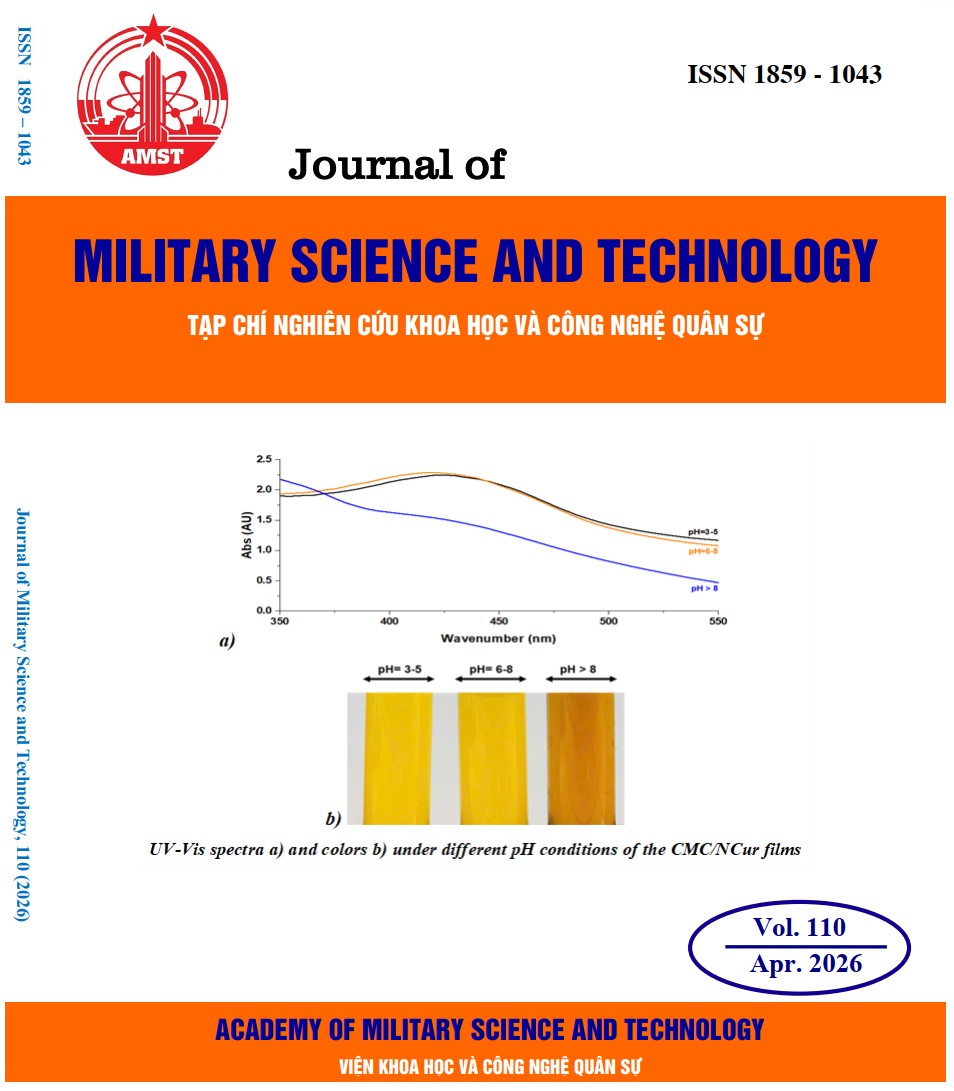
Phát triển màng polyme sinh học tích hợp nanocurcumin nhằm tăng cường độ bền và khả năng theo dõi sự biến đổi pH
169 lượt xemDOI:
https://doi.org/10.54939/1859-1043.j.mst.110.2026.74-83Từ khóa:
Màng phân huỷ sinh học; Nanocurcumin; Chỉ thị pH; Bao bì thông minh.Tóm tắt
Nghiên cứu này phát triển các màng biopolymer thông minh từ chitosan (CS), carboxymethyl cellulose (CMC) và pectin (Pec) kết hợp với nanocurcumin (NCur). Các phân tích FE-SEM và ATR-FTIR xác nhận việc tích hợp NCur đã tạo ra cấu trúc đặc khít hơn, giúp cải thiện độ bền kéo và độ giãn dài lần lượt lên tới 17% và 20%. Bên cạnh việc giảm độ ẩm và tăng gấp đôi hoạt tính chống oxy hóa, màng còn thể hiện khả năng chuyển màu rõ rệt theo pH từ vàng (acid) sang nâu đỏ (kiềm). Thử nghiệm bảo quản thịt bò cho thấy màng theo dõi chính xác quá trình hư hỏng thông qua sự thay đổi màu sắc trong hai ngày. Kết quả khẳng định tiềm năng lớn của màng tích hợp NCur như một giải pháp bao bì thông minh giúp bảo quản chủ động và chỉ thị độ tươi thực phẩm.
Tài liệu tham khảo
[1]. P.G.C. Nayanathara Thathsarani Pilapitiya, A.S. Ratnayake – “The world of plastic waste: A review” – Clean. Mater. – vol. 11 – p. 100220 – (2024). DOI: 10.1016/j.clema.2024.100220. DOI: https://doi.org/10.1016/j.clema.2024.100220
[2]. G. Abbas, U. Ahmed, M.A. Ahmad – “Impact of Microplastics on Human Health: Risks, Diseases, and Affected Body Systems” – Microplastics – vol. 4 – pp. 1–21 – (2025). DOI: 10.3390/microplastics4020023. DOI: https://doi.org/10.3390/microplastics4020023
[3]. J. Yates, M. Deeney, J. Muncke, B. Carney Almroth, M.F. Dignac, A.C. Castillo, W. Courtene-Jones, S. Kadiyala, E. Kumar, P. Stoett, M. Wang, T. Farrelly – “Plastics matter in the food system” – Commun. Earth Environ. – vol. 6 – pp. 5–9 – (2025). DOI: 10.1038/s43247-025-02105-7. DOI: https://doi.org/10.1038/s43247-025-02105-7
[4]. M. Nasrollahzadeh, M. Sajjadi, S. Iravani, R.S. Varma – “Starch, cellulose, pectin, gum, alginate, chitin and chitosan derived (nano)materials for sustainable water treatment: A review” – Carbohydr. Polym. – vol. 251 – (2021). DOI: 10.1016/j.carbpol.2020.116986. DOI: https://doi.org/10.1016/j.carbpol.2020.116986
[5]. J. Fiallos-Núñez, Y. Cardero, G. Cabrera-Barjas, C.M. García-Herrera, M. Inostroza, M. Estevez, B.L. España-Sánchez, L.M. Valenzuela – “Eco-Friendly Design of Chitosan-Based Films with Biodegradable Properties as an Alternative to Low-Density Polyethylene Packaging” – Polymers (Basel). – vol. 16 – (2024). DOI: 10.3390/polym16172471. DOI: https://doi.org/10.3390/polym16172471
[6]. C.T.K. Nguyen, K.Q. Tran, A.T.L. Nguyen, L.L.P. Dang, H.N. Le, K.D. Do, Q.X. Duong, H.H. Do, V.D. Nguyen, T.H.A. Ngo – “Nanoarchitectonics of antibacterial bio-packaging film from grapefruit peel-derived low methoxy Pectin integrated with silver nanoparticles” – J. Polym. Res. – vol. 32 – (2025). DOI: 10.1007/s10965-025-04314-2. DOI: https://doi.org/10.1007/s10965-025-04314-2
[7]. J.R. Westlake, M.W. Tran, Y. Jiang, X. Zhang, A.D. Burrows, M. Xie – “Biodegradable biopolymers for active packaging: demand, development and directions” – Sustain. Food Technol. – vol. 1 – pp. 50–72 – (2023). DOI: 10.1039/d2fb00004k. DOI: https://doi.org/10.1039/D2FB00004K
[8]. A. Dirpan, A.F. Ainani, M. Djalal – “A Review on Biopolymer-Based Biodegradable Film for Food Packaging: Trends over the Last Decade and Future Research” – Polymers (Basel). – vol. 15 – (2023). DOI: 10.3390/polym15132781. DOI: https://doi.org/10.3390/polym15132781
[9]. J. Xu, X. Liu, X. Ren, G. Gao – “The role of chemical and physical crosslinking in different deformation stages of hybrid hydrogels” – Eur. Polym. J. – vol. 100 – pp. 86–95 – (2018). DOI: 10.1016/j.eurpolymj.2018.01.020. DOI: https://doi.org/10.1016/j.eurpolymj.2018.01.020
[10]. J. Ghaderi, S.F. Hosseini, N. Keyvani, M.C. Gómez-Guillén – “Polymer blending effects on the physicochemical and structural features of the chitosan/poly(vinyl alcohol)/fish gelatin ternary biodegradable films” – Food Hydrocoll. – vol. 95 – pp. 122–132 – (2019). DOI: 10.1016/j.foodhyd.2019.04.021. DOI: https://doi.org/10.1016/j.foodhyd.2019.04.021
[11]. S.M. Ojagh, M. Rezaei, S.H. Razavi, S.M.H. Hosseini – “Development and evaluation of a novel biodegradable film made from chitosan and cinnamon essential oil with low affinity toward water” – Food Chem. – vol. 122 – pp. 161–166 – (2010). DOI: 10.1016/j.foodchem.2010.02.033. DOI: https://doi.org/10.1016/j.foodchem.2010.02.033
[12]. S. Tie, Q. Zhang, Y. Zhao, Y. Wu, D. Liu, L. Zhao, S. Gu – “Design and preparation of novel antioxidant and antibacterial films containing procyanidins and phycocyanin for food packaging” – RSC Adv. – vol. 14 – pp. 7572–7581 – (2024). DOI: 10.1039/d3ra08653d. DOI: https://doi.org/10.1039/D3RA08653D
[13]. C. Dai, J. Lin, H. Li, J. Shen, Z. Shen, Y. Wang, T. Velkov – “The Natural Product Curcumin as an Antibacterial Agent: Current Achievements and Problems” – Antioxidants – vol. 11 – (2022). DOI: 10.3390/antiox11030459. DOI: https://doi.org/10.3390/antiox11030459
[14]. Z. Munir, G. Banche, L. Cavallo, N. Mandras, J. Roana, R. Pertusio, E. Ficiarà, R. Cavalli, C. Guiot – “Exploitation of the Antibacterial Properties of Photoactivated Curcumin as ‘Green’ Tool for Food Preservation” – Int. J. Mol. Sci. – vol. 23 – (2022). DOI: 10.3390/ijms23052600. DOI: https://doi.org/10.3390/ijms23052600
[15]. X. Huang, J. He, L. Yao, Z. Zhu, J. Luo, P. Li, J. Wei, H. Zhong – “Curcumin sodium alginate-polyvinyl alcohol pH-indicating composite film for shrimp freshness monitoring” – Int. J. Biol. Macromol. – p. 147990 – (2025). DOI: https://doi.org/10.1016/j.ijbiomac.2025.147990
[16]. P. Rachtanapun, W. Klunklin, P. Jantrawut, K. Jantanasakulwong, Y. Phimolsiripol, P. Seesuriyachan, N. Leksawasdi, T. Chaiyaso, W. Ruksiriwanich, S. Phongthai, S.R. Sommano, W. Punyodom, A. Reungsang, T.M.P. Ngo – “Characterization of chitosan film incorporated with curcumin extract” – Polymers (Basel). – vol. 13 – pp. 1–15 – (2021). DOI: 10.3390/polym13060963. DOI: https://doi.org/10.3390/polym13060963
[17]. F. Wang, R. Wang, Y. Pan, M. Du, Y. Zhao, H. Liu – “Gelatin/Chitosan Films Incorporated with Curcumin Based on Photodynamic Inactivation Technology for Antibacterial Food Packaging” – Polymers (Basel). – vol. 14 – (2022). DOI: 10.3390/polym14081600. DOI: https://doi.org/10.3390/polym14081600
[18]. J. Meneses, T. van de Kemp, R. Costa-Almeida, R. Pereira, F.D. Magalhães, M. Castilho, A.M. Pinto – “Fabrication of Polymer/Graphene Biocomposites for Tissue Engineering” – Polymers (Basel). – vol. 14 – pp. 1–25 – (2022). DOI: 10.3390/polym14051038. DOI: https://doi.org/10.3390/polym14051038
[19]. E. Dube – “Nanoformulated Curcumin for Food Preservation: A Natural Antimicrobial in Active and Smart Packaging Systems” – (2025). DOI: https://doi.org/10.3390/applbiosci4040046
[20]. T. Gupta, J. Singh, S. Kaur, S. Sandhu, G. Singh, I.P. Kaur – “Enhancing Bioavailability and Stability of Curcumin Using Solid Lipid Nanoparticles (CLEN): A Covenant for Its Effectiveness” – Front. Bioeng. Biotechnol. – vol. 8 – pp. 1–14 – (2020). DOI: 10.3389/fbioe.2020.00879. DOI: https://doi.org/10.3389/fbioe.2020.00879
[21]. N. Van An, N. Thi, K. Chi, T.Q. Khanh, D.X. Quan, P.Q. Trung, N. Hong, A. Thu, N.V. An, N. Thị, K. Chi, T.Q. Khánh – “Extraction of Pectin and Cellulose from Grapefruit Peels and Production of Carboxymethyl Cellulose” – vol. 39 – pp. 49–58 – (2023).
[22]. B.K. Salunke, B.S. Kim – “Biosynthesis and applications of silver nanoparticles” – Emerg. Areas Bioeng. – pp. 579–590 – (2017). DOI: 10.1002/9783527803293.ch32. DOI: https://doi.org/10.1002/9783527803293.ch32
[23]. J. Jovanović, J. Ćirković, A. Radojković, D. Mutavdžić, G. Tanasijević, K. Joksimović, G. Bakić, G. Branković, Z. Branković – “Chitosan and pectin-based films and coatings with active components for application in antimicrobial food packaging” – Prog. Org. Coatings – vol. 158 – p. 106349 – (2021). DOI: https://doi.org/10.1016/j.porgcoat.2021.106349
[24]. A. Duan, J. Yang, L. Wu, T. Wang, Q. Liu, Y. Liu – “Preparation, physicochemical and application evaluation of raspberry anthocyanin and curcumin based on chitosan/starch/gelatin film” – Int. J. Biol. Macromol. – vol. 220 – pp. 147–158 – (2022). DOI: https://doi.org/10.1016/j.ijbiomac.2022.08.053
[25]. S.K. Borra, P.G. Prema Gurumurthy, J.M. Jaideep Mahendra, K.M. Jayamathi, C.N. Cherian, R.C. Ram Chand – “Antioxidant and free radical scavenging activity of curcumin determined by using different in vitro and ex vivo models.” – (2013).
[26]. A. Panwar, S. Kumar, A. Dhiman, V. Kumar, D. Gupta, A. Sharma – “pH sensitive indicator film based intelligent packaging systems of perishables: Developments and challenges of last decade” – Microchem. J. – vol. 207 – p. 111732 – (2024). DOI: https://doi.org/10.1016/j.microc.2024.111732
[27]. Y. Inatsu, M.L. Bari, S. Kawasaki, S. Kawamoto – “Effectiveness of some natural antimicrobial compounds in controlling pathogen or spoilage bacteria in lightly fermented Chinese cabbage” – J. Food Sci. – vol. 70 – (2005). DOI: 10.1111/j.1365-2621.2005.tb08323.x. DOI: https://doi.org/10.1111/j.1365-2621.2005.tb08323.x
[28]. C.A.C. Araújo, L.L. Leon – “Biological activities of Curcuma longa L” – Mem. Inst. Oswaldo Cruz – vol. 96 – pp. 723–728 – (2001). DOI: 10.1590/S0074-02762001000500026. DOI: https://doi.org/10.1590/S0074-02762001000500026
[29]. N. Chiaoprakobkij, T. Suwanmajo, N. Sanchavanakit, M. Phisalaphong – “Curcumin-Loaded Bacterial Cellulose/Alginate/Gelatin as A Multifunctional Biopolymer Composite Film” – Molecules – vol. 25 – pp. 1–18 – (2020). DOI: 10.3390/molecules25173800. DOI: https://doi.org/10.3390/molecules25173800
[30]. S. Wahyuningsih, L. Wulandari, M.W. Wartono, H. Munawaroh, A.H. Ramelan – “The Effect of pH and Color Stability of Anthocyanin on Food Colorant” – IOP Conf. Ser. Mater. Sci. Eng. – vol. 193 – (2017). DOI: 10.1088/1757-899X/193/1/012047. DOI: https://doi.org/10.1088/1757-899X/193/1/012047
[31]. Y. Mardiyati, A.N. Fauza, S. Steven, Hansen, S.M. Shoimah, O.A. Rachman, A. Nuruddin, R. Hidayat – “Initial study of curcumin extraction from turmeric as an indicator for basic solution detector” – Adv. Metall. Eng. Mater. Charact. Innov. – vol. 2538 – p. 50004 – (2023). DOI: https://doi.org/10.1063/5.0115465
[32]. A. Etxabide, P.A. Kilmartin, J.I. Maté – “Color stability and pH-indicator ability of curcumin, anthocyanin and betanin containing colorants under different storage conditions for intelligent packaging development” – Food Control – vol. 121 – pp. 1–30 – (2021). DOI: 10.1016/j.foodcont.2020.107645. DOI: https://doi.org/10.1016/j.foodcont.2020.107645
[33]. C.M.A. Gangemi, S. Mirabile, M. Monforte, A. Barattucci, P.M. Bonaccorsi – “Bioimaging and Sensing Properties of Curcumin and Derivatives” – Int. J. Mol. Sci. – vol. 26 – (2025). DOI: 10.3390/ijms26104871. DOI: https://doi.org/10.3390/ijms26104871
[34]. İ. Gulcin – “Antioxidants: a comprehensive review” – (2025). DOI: 10.1007/s00204-025-03997-2. DOI: https://doi.org/10.1007/s00204-025-03997-2
[35]. P.E. Athanasiou, M. Patila, R. Fotiadou, I. Giotopoulou, N.M. Barkoula, E. Voutsas, H. Stamatis – “pH-Responsive Chitosan Films Enriched with NADES-Extracted Wine Lees Anthocyanins for In Situ Food Monitoring” – Gels – vol. 11 – pp. 1–24 – (2025). DOI: 10.3390/gels11090676. DOI: https://doi.org/10.3390/gels11090676
[36]. S. Gómez, P. Lafiosca – “Modeling UV / Vis Absorption Spectra of Food Colorants in Solution: Anthocyanins and Curcumin as Case Studies” – pp. 1–20 – (2024). DOI: https://doi.org/10.3390/molecules29184378